12-Month Astrology Forecast Sample
Quick answer
Most horoscopes for the year are written for a sign, so everyone with that sign reads the same words. This forecast starts from a whole birth chart. The slow planets are counted from your own Moon, the faster ones from your own lagna, and the running dasha is your own. Below you can see every page of a sample made for a made-up person, Priya Sharma.
Key takeaways
- A rolling twelve months from the day your report is made.
- One section per month, split at every real change, so a month is never judged by its first day.
- Dates and times shown in the time zone you choose, with the zone named.
- Your mahadasha and antardasha are kept clearly apart.
- No percentages and no promised events, because tradition offers neither.
What does the 12-Month Forecast look like?
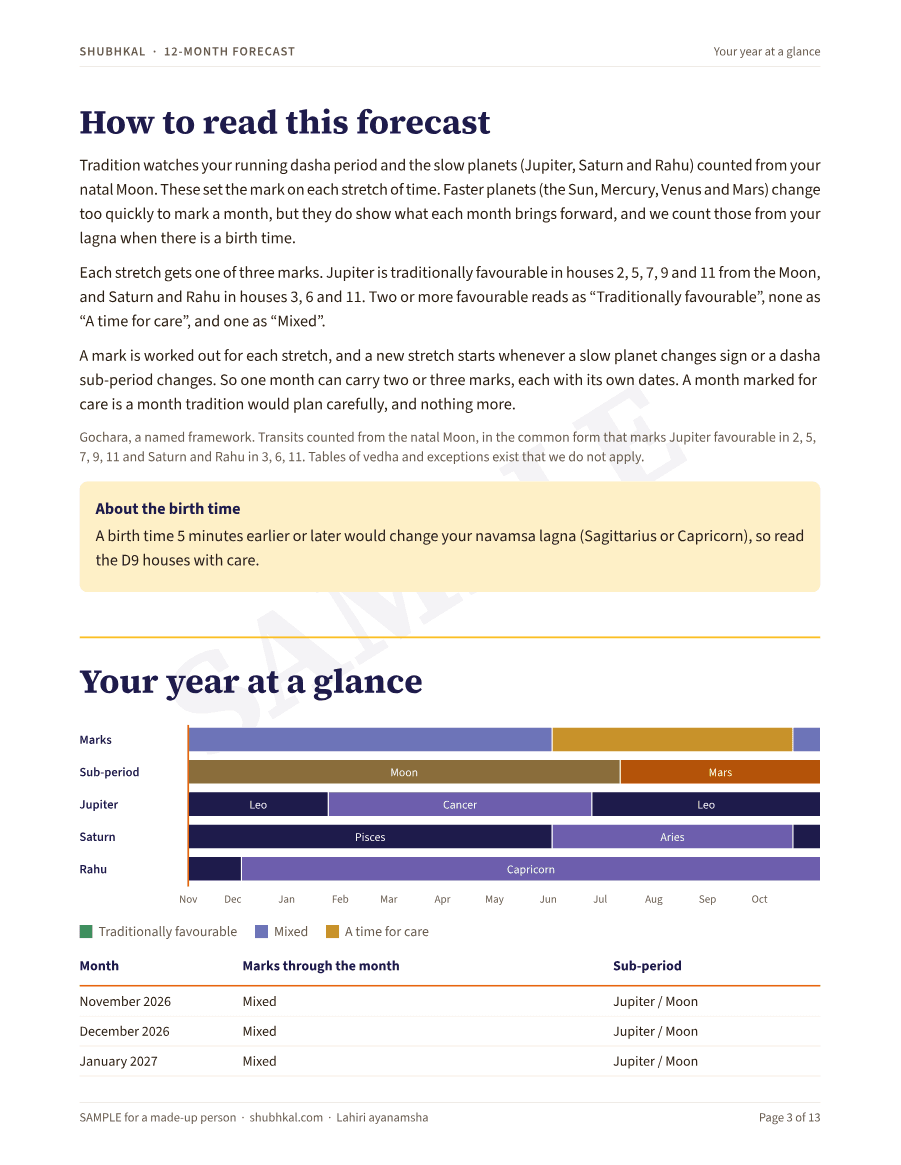
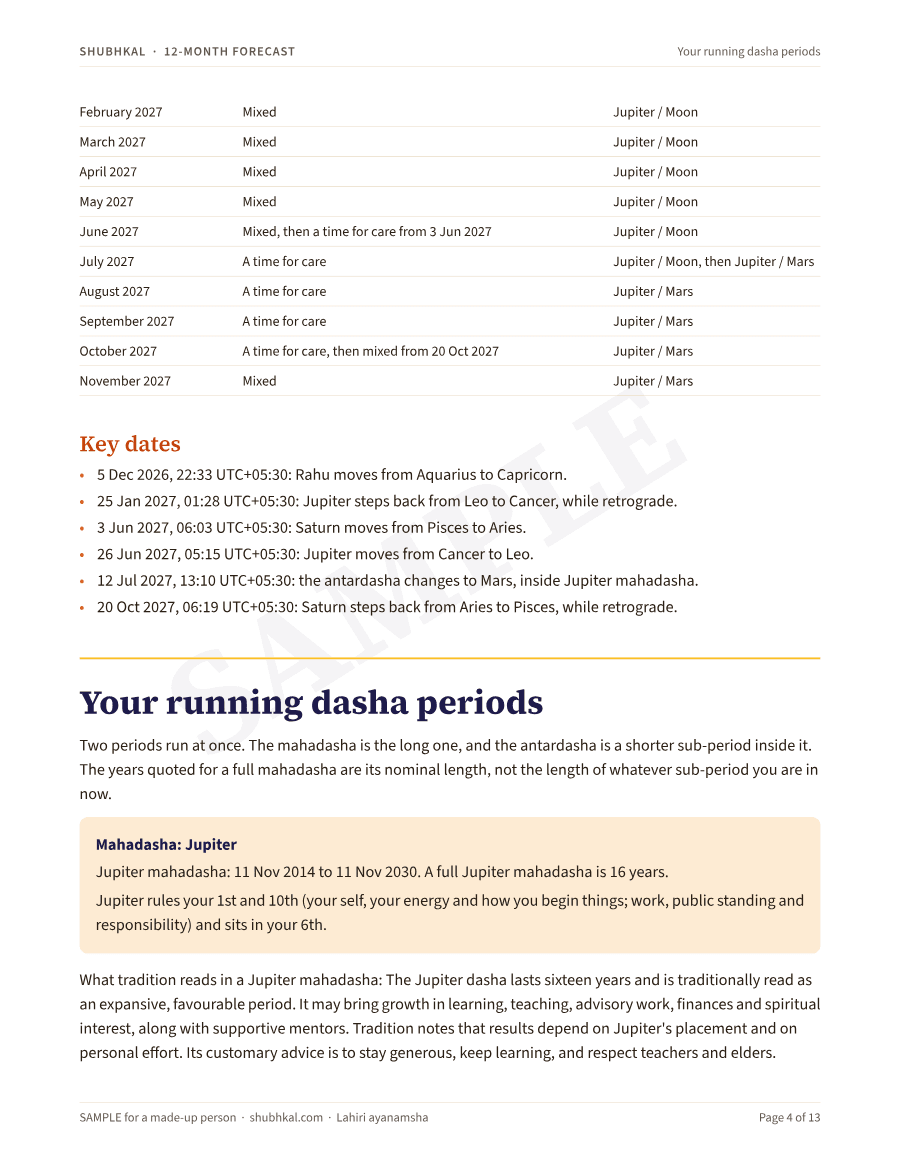
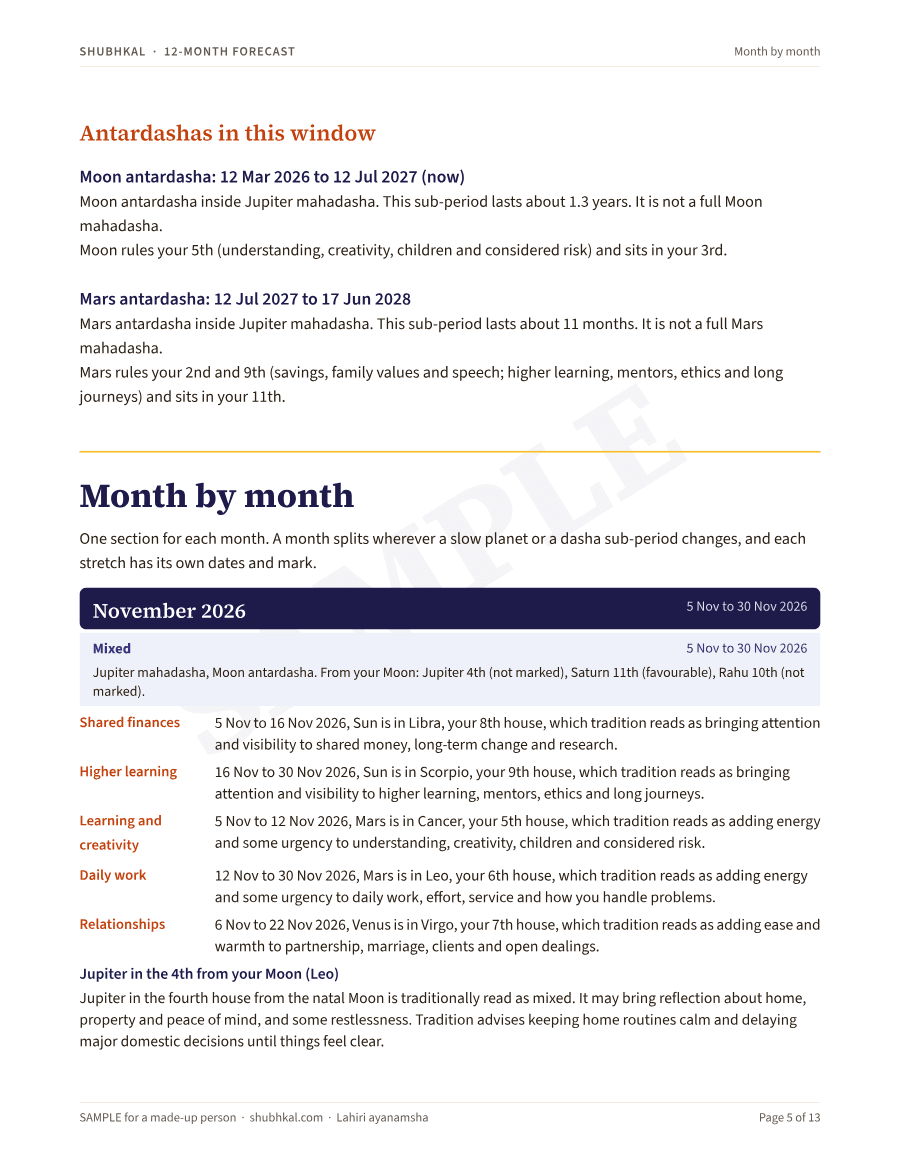
These are real pages from the sample, marked SAMPLE because the person is made up. The full report runs to about 14 pages. Tap a page to open the whole PDF.
What is inside the 12-Month Forecast?
How to read it
The marking rule in plain words: which houses from the Moon tradition treats as favourable for Jupiter, Saturn and Rahu, and how those become a mark for each stretch of time.
Your year at a glance
A timeline of marks, dasha sub-periods and the signs of Jupiter, Saturn and Rahu, followed by a month table and every key date, with its exact moment and time zone.
Your running dasha periods
The mahadasha and each antardasha in the window, with real dates. A full mahadasha's nominal length is kept apart from the sub-period you are actually in, so a short sub-period is never described as a 19-year dasha.
Month by month
One section for each month. When something changes partway through, the month splits into dated stretches, each with its own mark. Themes for work, money, learning, relationships, family and well-being come from where the moving planets really fall in your chart, and each month ends with a question to think about.
Saturn this year
Every entry, exit and return. Saturn can step back across a sign line while retrograde, so a phase can stop and start again, and the report shows date ranges with no single misleading end date.
Summary and reflection
Where the slow planets touch your life areas, and a few questions for the year.
It is made automatically after payment from the birth details you enter, by the same code that made this sample. Nothing is written by hand, so the same details always give the same calculations.
Who is the 12-Month Forecast for?
It suits you if
- You like to plan a year ahead and want to know what tradition would watch
- You want dates in your own time zone, wherever you live
- You want to see the reasoning, not only a verdict
It may not suit you if
- You want a date when a specific event will happen
- You are looking for advice on medical, legal or money decisions
- You do not have a birth time, as this relies on your chart
How is this sample made, and can you trust the numbers?
This sample comes from the same report code as a paid order, with one difference: the SAMPLE marks. The person is made up, so we can show every page. Positions use the Lahiri ayanamsha, the standard of the Indian government's calendar committee, with the mean node for Rahu and Ketu, whole-sign houses and the time zone rules of the birth date and place. We checked planet and lagna positions against Swiss Ephemeris. Where traditions differ, the report says which convention it uses, and our kundali calculators page lists them all. The positions are astronomy. What they mean comes from a cultural and religious tradition, which is not a proven way to predict events, and the report never presents it as one. If you want to check a chart before paying, the free birth chart uses the same calculations.
What do these terms mean?
- Gochara
- Reading the current positions of planets, counted from your natal Moon.
- Mahadasha
- The long planetary period you are in. Each planet has a fixed nominal length, from 6 to 20 years.
- Antardasha
- A shorter sub-period inside a mahadasha, usually months to a few years long.
- Retrograde
- When a planet appears to move backwards from Earth. This is how a planet can step back into the sign it just left.
- Sade Sati
- Saturn's passage through the sign before your Moon sign, your Moon sign and the sign after it, about seven and a half years in all.
- Dhaiya
- Saturn in the 4th or 8th sign from your Moon, for about two and a half years.
- Mean node
- One of two ways of calculating Rahu and Ketu. We use the mean node, and some sites use the true node, up to about two degrees away.
- Transit
- A planet's present position, as compared with your birth chart.
What does it cost, and what happens after you pay?
The 12-Month Forecast comes as part of the Complete Kundali Bundle: Complete Kundali, 12-Month Forecast, Personal Life Areas Guide, Kundali Matching Report, for one payment of USD 29, tax included. It is not a subscription. Your reports are made automatically after payment and appear on your order page, where you can download them for 30 days. All sales are final once delivered, because they are personalised digital files, and we refund in full if you were charged twice. Your legal rights in your country are not affected.
Get the bundle, $29Frequently asked questions
Does the forecast start from January or from today?
It runs twelve months from the day your report is made, so it never spends pages on months already gone. The window is cut by calendar months in your time zone, which means the first and last month can be partial and there can be thirteen short sections. Each one shows exactly which dates it covers.
Why does one month show more than one mark?
Because something changed during that month. If Saturn moves sign on the 3rd or a sub-period changes on the 12th, the days before and after really are different by the rule we use. So we split the month at that moment and mark each stretch, instead of judging the whole month by its first day.
Which time zone are the dates in?
The one you choose when you order, or the zone of your birthplace if you leave that alone. The zone and its offset are named in the report, and each key date shows its clock time and offset. A change close to midnight can fall on a different date elsewhere, which is why we state the zone instead of assuming it.
Does the forecast tell me what will happen?
No. It tells you what tradition watches in these months and how it reads them, marked as favourable, mixed or a time for care. Those marks describe a traditional rule, and they are not forecasts of events. There are no probabilities in the report, because the tradition offers none, and we would be making them up.
Why is Saturn's Sade Sati shown with so many dates?
Saturn's retrograde motion can carry it back across a sign line, so a phase can seem to end and then resume months later. A single end date would be misleading. For example, Saturn leaves Pisces on 3 June 2027 and returns on 20 October 2027 before leaving again in February 2028, and the report lists each of those.
Is the forecast sold on its own?
No, it comes as part of the Complete Kundali Bundle, which is one payment of USD 29, tax included, for all the reports. The forecast is made from the same birth details as your other reports, using the same calculations, so they never disagree with one another. The price is the same whichever report brought you here.
Related Tools
For guidance and tradition. Not a substitute for professional advice. The sample person is made up. No customer's report or birth details are ever published.