Kundali Matching Report Sample: Gun Milan and Porutham
Quick answer
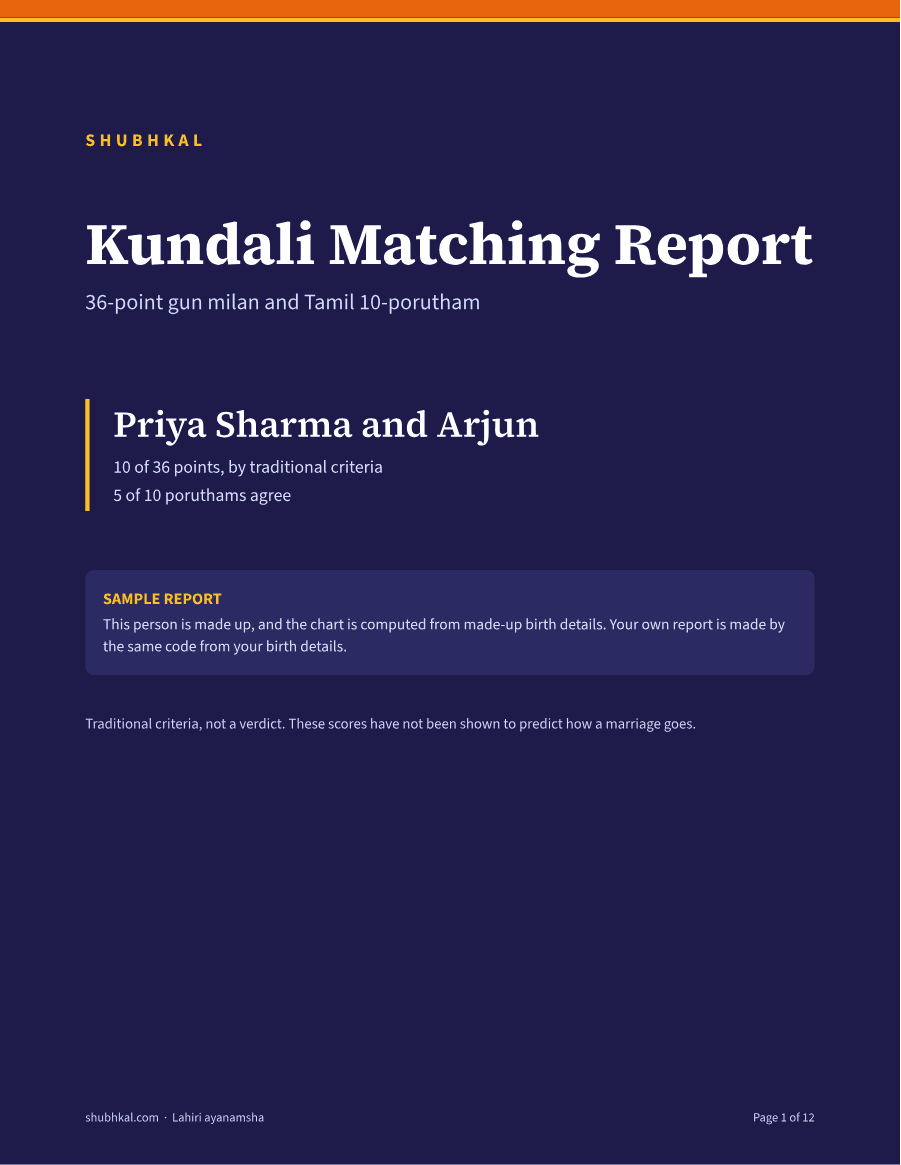
Kundali matching, called gun milan in Hindi and porutham in Tamil and Telugu, compares two charts before a marriage. Many families take it seriously, and a single number can carry a lot of weight. So this report shows what the number is made of, what it does not read, and where traditions differ. The sample compares two made-up people: Priya Sharma, and Arjun, born 3 June 1990 at 21:15 in Edison, NJ.
Key takeaways
- A one-page summary to print, then the detail behind it.
- All eight kootas and all ten poruthams, each explained.
- Nadi and Bhakoot exceptions are listed, and never silently applied.
- Scores are labelled as traditional criteria, not verdicts.
- A second person can add their own details privately.
What does the Kundali Matching Report look like?
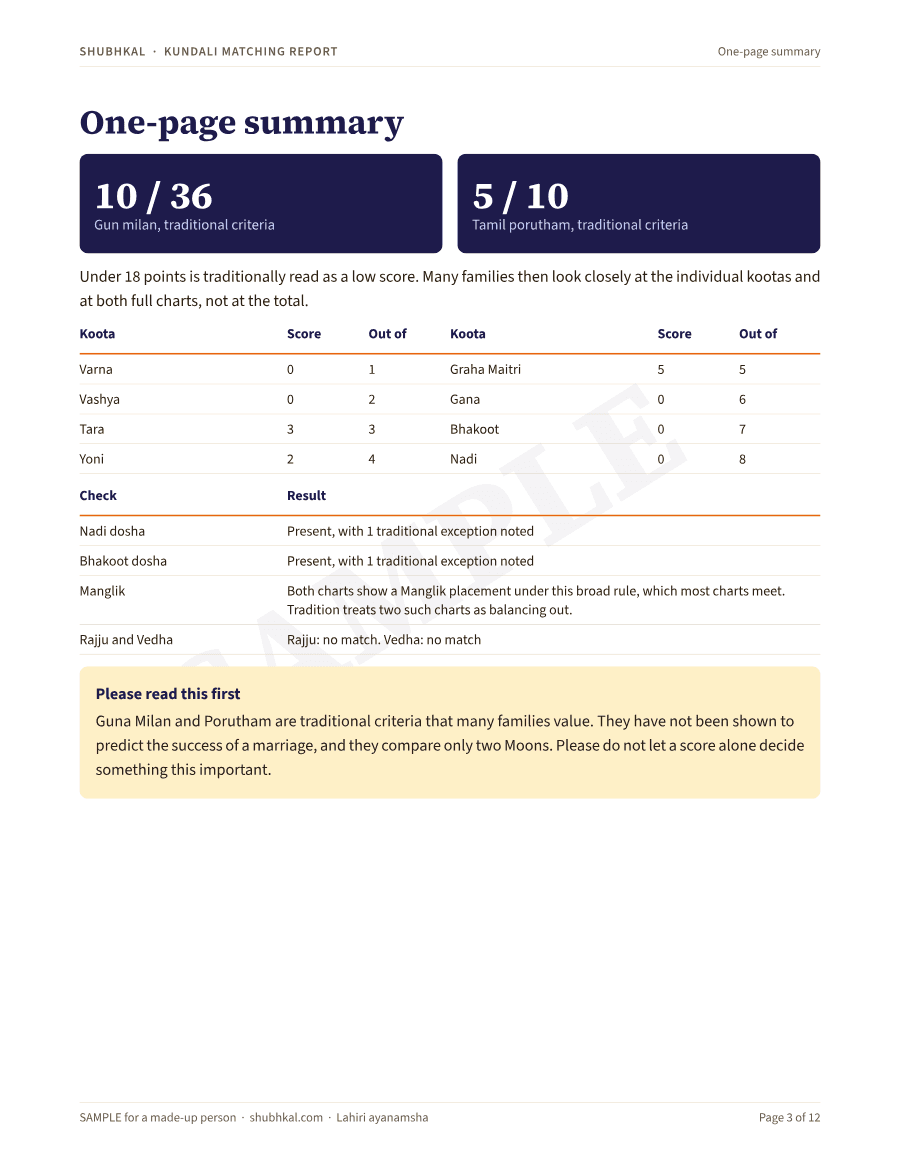
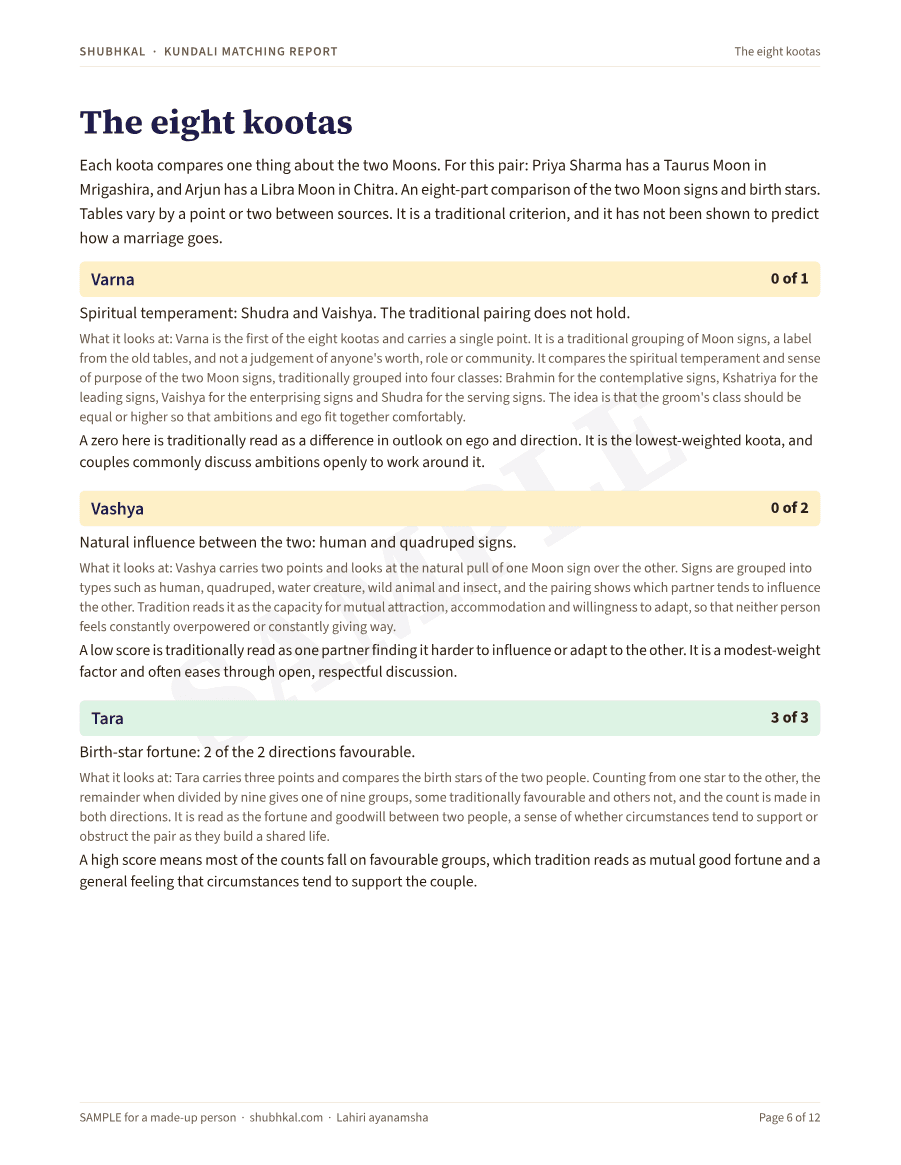
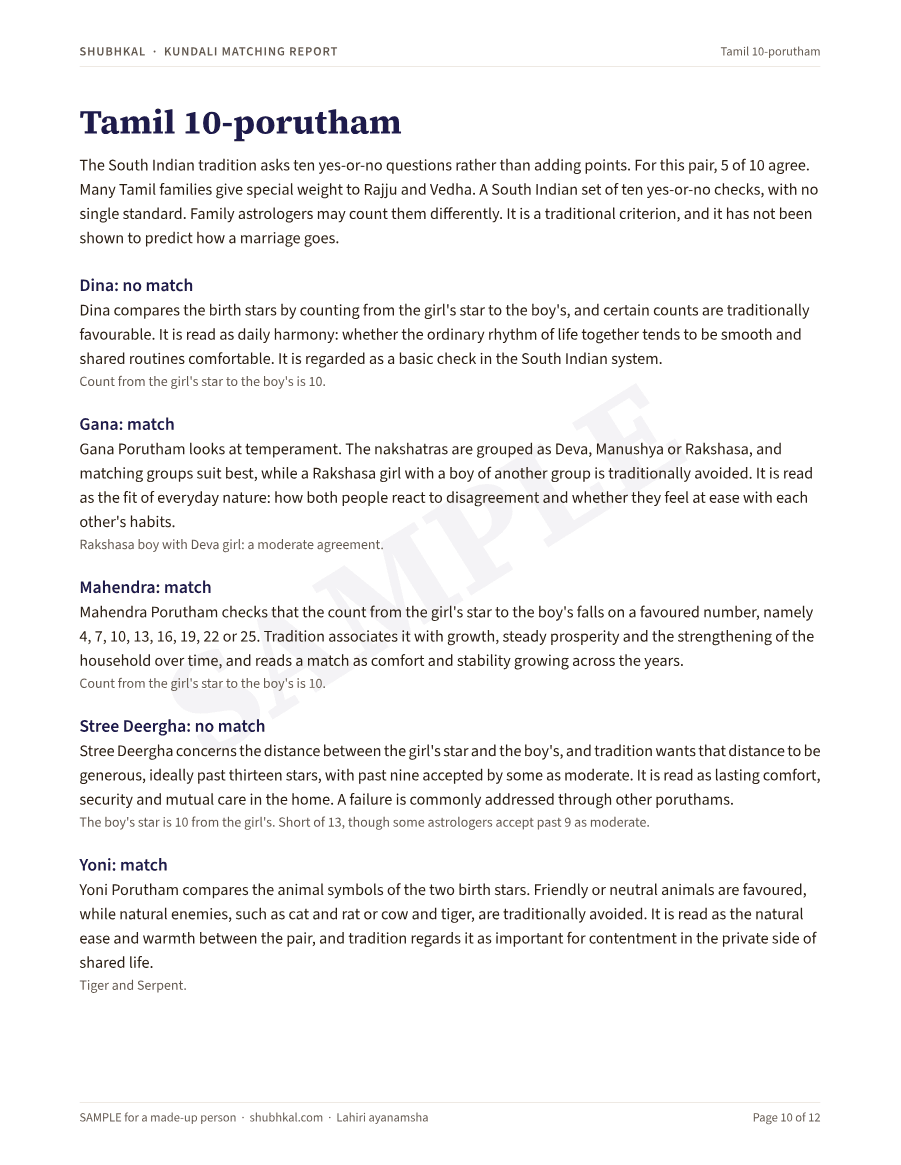
These are real pages from the sample, marked SAMPLE because the person is made up. The full report runs to about 12 pages. Tap a page to open the whole PDF.
What is inside the Kundali Matching Report?
One-page summary
The gun milan total and porutham count, every koota score, Nadi and Bhakoot status, the Manglik comparison, and a plain note on what these scores can and cannot tell you.
The two charts
Each person's Moon sign and birth star, with full charts when the buyer entered the details. When the second person used their own private link, their birth details and chart stay out of the report.
The eight kootas
Varna, Vashya, Tara, Yoni, Graha Maitri, Gana, Bhakoot and Nadi: what each compares, how this pair scored and what a full or low score is traditionally taken to mean.
Nadi, Bhakoot and Manglik
Whether each dosha is present and which standard exceptions hold. The exceptions are reported and the score is left as calculated, because traditions differ on whether they cancel it.
Tamil 10-porutham
Ten yes-or-no checks in the South Indian tradition, including Rajju and Vedha, which many Tamil families weigh most heavily.
What it does not read
The score reads only the two Moons. The report does not use the navamsa, and gives no marriage dates or timing. It cannot tell you how two people will treat each other, handle money or raise a family, and it says so.
How to read a score
Tradition reads under 18 points as low, 18 to 24 as acceptable, 25 to 32 as good and 33 or more as excellent. Those bands are a convention, and many families look past the total to individual kootas, especially Nadi and Bhakoot, and to any exception that applies. A total that looks low can have an exception that many families accept, and a total that looks high can hide a koota they care about. That is why the report shows every part of the score, and leaves the judgement to you and your family.
It is made automatically after payment from the birth details you enter, by the same code that made this sample. Nothing is written by hand, so the same details always give the same calculations.
Who is the Kundali Matching Report for?
It suits you if
- Your family uses gun milan or porutham, and you want to understand a score
- You want to see the exceptions, not only a total
- You want something to take to a family pandit
It may not suit you if
- You want to be told whether to marry someone
- Either person is under 18, as we do not make matching reports for minors
- You do not have the other person's permission to use their details
How is this sample made, and can you trust the numbers?
This sample comes from the same report code as a paid order, with one difference: the SAMPLE marks. The person is made up, so we can show every page. Positions use the Lahiri ayanamsha, the standard of the Indian government's calendar committee, with the mean node for Rahu and Ketu, whole-sign houses and the time zone rules of the birth date and place. We checked planet and lagna positions against Swiss Ephemeris. Where traditions differ, the report says which convention it uses, and our kundali calculators page lists them all. The positions are astronomy. What they mean comes from a cultural and religious tradition, which is not a proven way to predict events, and the report never presents it as one. If you want to check a chart before paying, the free birth chart uses the same calculations.
What do these terms mean?
- Gun milan (Ashtakoot)
- A traditional comparison of two Moons across eight categories, scored out of 36.
- Koota
- One of those eight categories.
- Porutham
- A South Indian set of ten yes-or-no checks, with no single standard.
- Nadi
- A three-part grouping of birth stars. Two people in the same group have Nadi dosha, the 8-point koota.
- Bhakoot
- A check on how the two Moon signs sit from each other, worth 7 points.
- Manglik
- A broad check for Mars in certain houses, counted from the lagna, the Moon and Venus.
- Rajju and Vedha
- Two porutham checks that many Tamil families give special weight.
- Guna
- Another word for the points in gun milan.
What does it cost, and what happens after you pay?
The Kundali Matching Report comes as part of the Complete Kundali Bundle: Complete Kundali, 12-Month Forecast, Personal Life Areas Guide, Kundali Matching Report, for one payment of USD 29, tax included. It is not a subscription. Your reports are made automatically after payment and appear on your order page, where you can download them for 30 days. All sales are final once delivered, because they are personalised digital files, and we refund in full if you were charged twice. Your legal rights in your country are not affected.
Get the bundle, $29Frequently asked questions
Does a low gun milan score mean we should not marry?
No. A score is one traditional input, and it reads only the two Moons. It has not been shown to predict how a marriage goes. Many families look closely at the individual kootas and both full charts, and everything they know about the two people. Please do not let a number alone decide something this important.
Do I need the second person's details before I pay?
No. You can complete the Matching Report whenever you are ready, while your order page is working. You can enter the details yourself if you have the person's permission, or send them a private link so that they can enter their own and agree for themselves. The other reports are made straight away either way.
Can the other person keep their birth details private?
Yes. If they use their own private link, they enter their details and agree for themselves, and the report you receive shows their name, Moon sign, birth star and scores, without their birth date, time, place or full chart. That link cannot open your reports, and their details are deleted along with your order.
Why might another site give a different score?
Scoring tables differ a little between traditions and websites, so a total can be a few points away, and that is normal. Some tables also treat bride and groom differently, so we ask for gender. If it is not given for both people, the report shows the total read both ways, and does not pick one silently.
Does this report use the navamsa or give marriage dates?
No to both. The eight kootas and ten poruthams read only the two Moons' signs and birth stars, and the Manglik comparison also counts from each lagna, Moon and Venus. The report does not read the D9 chart for compatibility, and it gives no marriage dates or timing. It says this plainly instead of implying more.
Can we order a matching report for someone under 18?
No. Matching is a marriage matter, so we do not make these reports for anyone under 18, even when a parent asks. A parent or guardian can order the other reports for a child, which leave out marriage altogether and read learning, family and strengths instead. Both people in a Matching Report must be adults who have agreed to it.
Is a missing birth time treated as exact?
No. A paid Matching Report needs a birth time for both people, because the Manglik comparison counts from each lagna. The free matching tool works without one and shows what can honestly be said, including a range when the Moon changed sign that day. We never present a guessed time as an exact one.
Related Tools
For guidance and tradition. Not a substitute for professional advice. The sample person is made up. No customer's report or birth details are ever published.